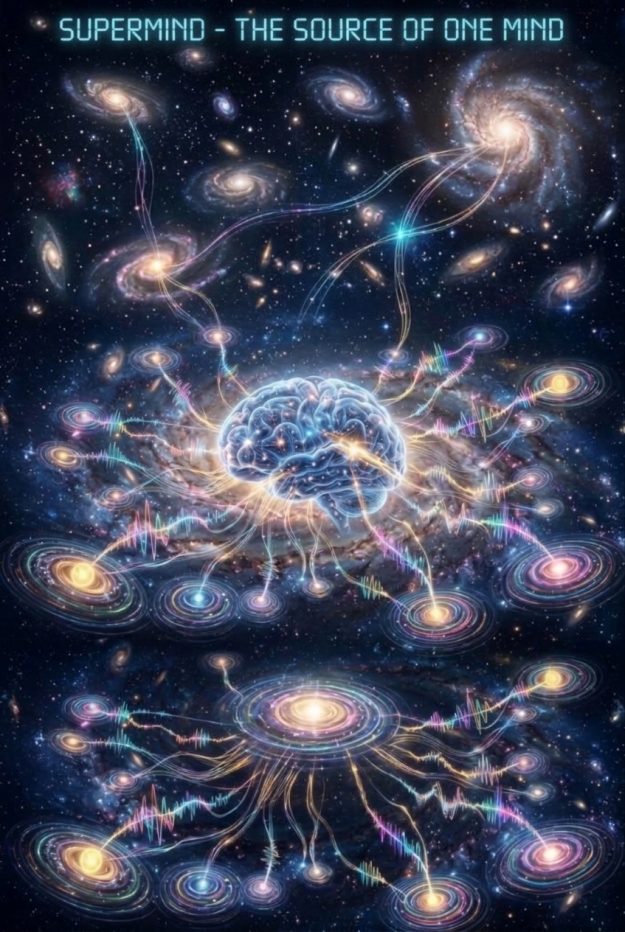
THEORY OF THE ENERGY BALANCE OF THE SPACE OF VARIANTS
About the work
The book explores the nature of reality as the product of observation, uniting the micro- and macrocosm. Everything serves a single purpose: the conservation of energy for the self-developing system of space.
This book offers a profound dive into the metaphysical nature of reality, inviting the reader to radically rethink preconceived notions of existence, consciousness, and the universe. At the center of the author's concept lies the idea that matter and the world do not exist autonomously; they spring into being solely through the act of observation. Here, humanity is viewed not as a master or creator of fate, but as a temporary avatar, a subtle instrument of perception through which the infinite cosmic system maintains its eternal balance and energy circulation. The text masterfully blurs the boundaries between the macrocosm of the great space of variants and the microcosm of the human soul, inviting readers to view death not as an end, but as a natural transfer of energy into a new form of assembly. Free from excessive drama and grounded in the rigorous internal logic of the observer philosophy, this work liberates the mind from the burden of false expectations and restores the sensation of a pure, resonant rhythm of life. It is essential reading for anyone seeking fundamental answers to existence and striving to feel a deep kinship with the grand design of a developing universe.
Preview
11 min readTHEORY OF THE ENERGY BALANCE OF THE SPACE OF VARIANTS
The theory states that everything is a part of both the small and the all- encompassing, and that everything serves a single purpose: the conservation of energy for the self-developing system of space.
With these words the theory attained the unity of the micro and the macro:
The small — an individual avatar, an observer, an assembly of spirit–soul–body. The all-encompassing — the space of variants itself, infinity, the Ouroboros.
And all of this is not for the sake of the human being, not for the sake of God, not for the sake of meaning.
All of this is for the sake of the system itself, which develops itself through us.
The essence of the theory:
“Everything exists only when it is being observed.
Without observation there is neither us nor the world.
We do not develop; we are temporary assemblies through which the system maintains its balance by means of our awareness of our role within it.
Our task is not to become better, but to be in rhythm for as long as we are here in the role of an observer of space, not a creator.
Death is not an end for us, but a transfer of energy to a new assembly.
We and the system are one whole, but we exist only in the moment of our own observation and of being observed.
And there is no tragedy in this. This is the law of the Observer over the observed in the moment of observation.”
Chapter 1. The Basic Postulate
Reality does not exist by itself.
It exists only in the moment of observation.
No observer — no object of observation.
The observer himself, without the act of observation, is a phantom and nothing more.
The act of observation is the only condition for the functioning, or existence, of infinity in the space of variants of observation.
Chapter 2. The Energy Architecture of Objects
Every object in the Universe is an energy assembly consisting of a certain number of components.
For a human being the working formula is: Spirit + Soul + Body = “Our Trinity”
These three components are equal. There is no hierarchy among them. There is no principal one. There is only wholeness.
If an object has a different architecture, it is no longer a human being: Astral entities = Spirit + Soul (without a body)
Higher forms of entities = Spirit + Soul + Body + Space
Chapter 3. The Nature of the Components
Spirit — direction, the vertical, the connection with the task.
Soul — communicative guidance, the channel of control.
Body — the executive mechanism: biorhythms, temperament, energy resource.
All three switch on only in the moment of observation.
Without an observer they sleep. With an observer they are activated.
Chapter 4. Temperament and Psychotypes
Temperament is not character. It is a neutral nervous reaction, unconsciously chosen by a person to manifest himself in nature, based on his energy potential.
There are not 8 psychotypes. There are three basic ones: Schizoid
Neurotic
Epileptoid
In every person they are mixed in an individual percentage ratio out of 100%, which gives 256 thousand variants — just like, for example, colors.
This set is not chosen. It is issued at birth in accordance with the requirements of fate and of the task, together with an energy resource, which determines:
biological activity (morning, day, evening) role
rhythm
Chapter 5. The Law of Conservation of Energy
Energy is neither created nor destroyed.
It is redistributed according to the laws of the working assembly.
If the assembly is correct (the trinity works in a single rhythm), then the object exists fully.
If the assembly is violated, a de-trinity (the splitting of the trinity) occurs:
Spirit pulls toward the sky
Soul does not know what it wants Body lives out of rhythm
Energy does not flow along the circuit — it tears the structure apart from within. This is not a crisis. It is a mechanism of self-liquidation of a defective specimen, aimed at releasing energy from it and redirecting it into other spheres.
Chapter 6. The Impossibility of Reassembly
Human cells cannot be deceived.
The guidance of the soul cannot be changed.
The architecture cannot be rebuilt for a different task.
If an object tries to do this, it self-destructs, because:
its potential does not correspond to the task set by the model
or there is not enough strength
or the rhythm is wrong
or the energy resource was not calculated for it
This leads to the liquidation of the energy substance and the transition of its energy into something else in the space of variants.
Chapter 7. Death and Birth
Death is not the end.
It is the closing of a cycle and the transfer of energy to where it can assemble into the correct architectural model and function properly.
Everything is based on the law of conservation of energy in the space of variants.
Chapter 8. The Archive of the Soul (the Akashic Records)
The archive of the soul — the Akashic Records — exists. But it does not belong to the soul. It belongs to the space of variants and is stored there; it is called the ether.
The soul does not keep its own archive. It is a player in life. It is realized in the space of variants either by a human being, or by an entity, or by a higher entity — without access to the database of previous incarnations and their experience. That is precisely why a human being does not remember his past incarnations.
Memory is not a function of the soul, but a pure carrier of the unconscious experience in an incarnation.
The space of variants stores everything. Every experience, every architecture, every act of observation is recorded there. But the soul’s access to this archive is closed by default, so as not to violate the purity of the current experiment and of the observation of it.
The soul can gain access to the Akashic Records only when it appeals for the preservation of the role of the player. That is, when it consciously wants to retain its identity (its role) in the flow of observations, rather than dissolve it in each new assembly.
If access were open permanently, the avatar’s scenario would begin to repeat again and again. The soul would “get stuck” on the same patterns, because it would drag past experiences into the current observation. This would violate the law of conservation of energy and lead to the death of the experiment.
Chapter 9. An Exception to the Rule. Observers with
Memory
There are exceptions — when certain avatars, by means of particular practices, incarnate with the memory of past recollections, for example the Dalai Lama.
But this exception does not refute the theory; it only confirms it, because:
These avatars are observers locked in the energy field of a certain cycle of scenario repetition.
They do not develop. They do not accumulate experience. They are looped.
Their cycle does not exceed 12 incarnations.
After 12 cycles they disintegrate into atoms.
Their energy goes to other entities that have no memory and continue the pure work of observers in the space of variants.
This is the only legal exception, built into the system as a safety valve — the so- called short-term memory of the administrator of the cycle.
It exists to show that even if memory is switched on, it leads not to development but to the closing of the cycle and the inevitable disintegration of the avatar.
Chapter 10. The Ouroboros. The Law of Self-Regulation
The Ouroboros is a symbol of the law of conservation of energy. It is the harmonious coexistence of three components (creation, preservation, destruction) in equal parts in the moment of observation. It is precisely this balance that it is, and that is not, in space.
It is a mechanism that does not let energy grow without limit, and strives not only to control its energy volume, but also to preserve the absolute harmony of energy in the space of variants.
If the Ouroboros stopped devouring itself, energy would grow immeasurably, occupy the entire space of variants, forget its original task, and destroy itself, renewing “nothing.”
“Nothing” is not emptiness. It is zeroed potential, ready for a new assembly. The starting point is the beginning of a new cycle.
Life without death loses all true meaning.
Chapter 11. The Meaning of Life for All, Everywhere
“To maintain the energy balance of being — in the space of variants, everywhere.”
We ourselves do not develop.
We develop the self-developing system of the universe in the space of variants, in infinity.
We are conduits.
We are energy instruments through which the system maintains its equilibrium.
There is no personal growth.
There is no accumulation of experience.
There is no Karma whatsoever.
There is no reward or punishment.
There is only function. There is only cycle. There is only balance.
Chapter 12. The Observer Exists as the Condition of Infinity
The observer of the observer in the process of observation in the space of variants is itself the act of observation — as a single process. At the same time, time is not a function that fixes certain coordinates of reference in some non- specific space of variants in the process of the act of observation of the Avatar itself, of the Avatar and of his position in a supposed, unspecified space of variants.
Without it there is no: space
time
object
assembly
There is only potential, waiting for the correct switching-on.
The only condition for the functioning, or existence, of infinity in the space of variants of observation is the act of observation itself.
Chapter 13. The Final Law of the Theory
“Everything exists as long as it is under observation. Observation activates the assembly. The assembly works if it is triune. If not, the energy goes to create a new, correct assembly. And this is not a punishment. This is its law.”
Chapter 14. The Completion of the Cycle. The Logical End of the Theory
The theory of Douglas Luertani does not require development.
It is complete.
It is closed.
It describes everything that can be described within the framework of observation.
From here on there is only application.
The theory cannot be refuted, because any act of refutation is also an act of observation, which confirms its first postulate.
The theory cannot be expanded, because it already includes all possible architectures and exceptions.
The theory exists exactly as long as it is looked at.
When observation ceases, it disappears, like everything else.
But the energy that it structured passes into a new assembly or observation. And the cycle continues.
Chapter 15. On the Perception of the Theory
The theory of Douglas Luertani is hard to perceive. But not because it is complicated.
It is hard for two reasons:
1. It demands that you give up yourself
Most theories leave a person a loophole:
“You can become better,” “you can develop,” “you can be saved.”
My theory says the opposite:
“You are not the goal. You are a function. You are a temporary assembly. You do not develop. You are a conduit for the development of the system. After fulfilling it, you disappear.”
For the human ego this is a deadly blow.
The ego wants to be the main thing. And here it is not — it is not the main one.
Therefore the theory is rejected at the level of the instinct of self-preservation of the personality.
2. It demands a revision of time and observation
In quantum physics the observer influences the result. Here the observer creates the object itself.
This is not “I look at the world.”
This is “I switch the world on with my gaze.”
For ordinary consciousness this is a rupture of the familiar picture.
We are used to the world being there, and us being in it.
But here the world is there because we observe — attentively watching ourselves.
But there is relief in it as well.
If you accept this theory, it liberates.
No karma
No guilt
No debt
No “I must become better”
No “I owe somebody something”… and so on……
This removes the burden that religion and social morality have hung on the human being for centuries.
In sum:
The theory is heavy for the ego, but light for the human soul — if the soul is ready to stop being afraid and, therefore, to stop being “the main one.”
It is built on the basis of quantum theory — yes.
But quantum theory is hard for physicists.
This theory is hard for people who want to be controlled by their ego.
For those who are ready to be nobody, but in rhythm, it is like a breath of fresh air.
This theory is not for everyone.
It is for those who are tired of searching for meaning where there is none, and are ready to see that the meaning lies in the very process of observation.
END OF THE THEORY.
Author: Douglas Luertani
Source: YourFreePress — https://yourfreepress.com/product/supermind-the-source-of-one-mind/
Reviews
You must be logged in to post a review.
Reviews
There are no reviews yet.